Getting there and the hour itself
Seville flamenco: what to expect
How to reach Calle Cuna, when to arrive, what happens on stage, how to follow the singing and dance, and what to see before or after the show.
Reserve your flamenco show ↗Quick answer
Plan to reach Calle Cuna 15 about 20 minutes before your session, because seats are taken in order of arrival. The show lasts one hour and is sung, danced and played, so you need no Spanish. Leave drinks outside, keep your phone away once it starts, and read the short list of palos in this guide to follow what the cast is doing. The theatre sits in central Seville, an easy walk from the Cathedral.
Finding Calle Cuna
Teatro Flamenco Sevilla is at Calle Cuna 15, in the centre of Seville. The theatre's own notes call the Cathedral, the Santa Cruz quarter and the Setas an easy walk, so most visitors arrive on foot. Plaza Nueva is served by the MetroCentro tram, line T1, and Puerta Jerez is both a stop on that tram and a Metro line 1 station. Either works as a starting point, and a map app will give the walking route from there.
When to arrive
The theatre states that seats are taken in strict order of arrival and advises being in the room 20 minutes before the show. Guests describe the doors opening around that time and the best seats going first, and some suggest arriving earlier still. Your confirmation carries the session time. If you want a place near the front, aim to be among the first people at the door rather than the last through it. That is why the theatre's own advice is simple: be in the room early. The theatre performs Pasión every day, in several sessions, and its calendar marks each as available, low availability or sold out. Choose the session that suits your day and plan back from it.
What happens in the hour
Pasión runs for one hour and the theatre schedules it every day. The order of the pieces is up to the artists, and the cast is subject to change. According to the theatre's notes on how its artists work, the lead passes between them: the guitar can open a passage, the dancer can signal a change, and the singer can hold a line longer than expected. Pauses count as part of the music, so expect some silences. The notes describe moments when a dancer begins a movement and the guitar answers, or the singer lengthens a phrase and the dance waits for the exact instant to continue.
Three arts on one stage
UNESCO describes flamenco as cante, baile and toque. The singing is traditionally done seated, without backing singers, with brief, simple lyrics that carry a wide range of emotions. The dance is described as one of passion and courtship, with men's technique relying more on footwork and women's movements gentler and more sensual. The guitar has moved well beyond accompaniment. Castanets, handclaps and foot-stamping add to the sound, so a good seat is as much about hearing as seeing. To follow it, listen for three things: the clap pattern, which carries the count; the voice, which sets the mood; and the dancer's calls, which signal that a change is coming.
Read next: Flamenco palos for first-timers
The language between the artists
The theatre's notes describe a shared code that the artists learn by listening. A llamada is a call by the dancer that signals a transition or an entry, and a remate closes a rhythmic phrase, often with footwork. Improvisation is part of it, so the singer can stretch a line and the guitar can adapt, but only within the compás. Silences carry meaning too. Watch the glances between the artists: much of what looks spontaneous is a conversation in a language you can learn to follow.
Where the art was performed before theatres
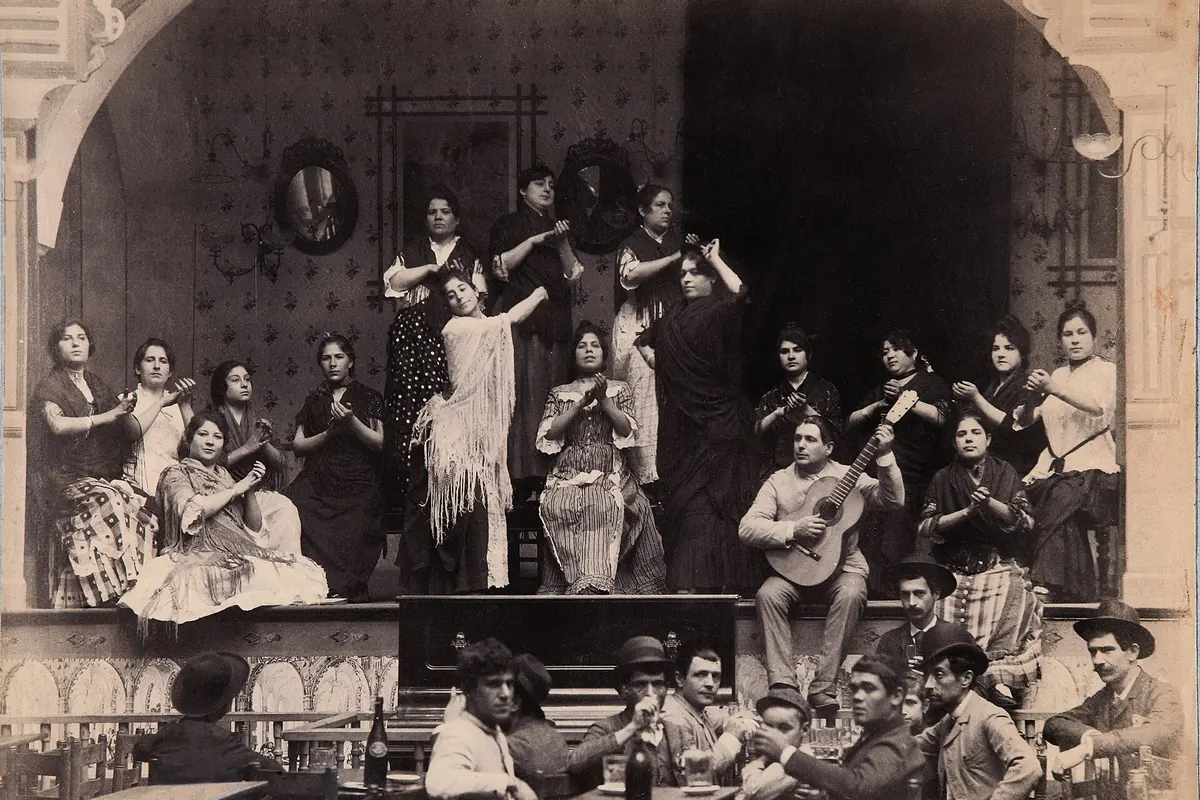
In the nineteenth century, flamenco moved from family gatherings into the cafés cantantes, where professional singers, dancers and guitarists performed for paying customers. Wikipedia dates the first of these in Seville to 1881, and the photograph shows a stage of the period: a raised platform, clapping seated women and a guitarist. Later, flamenco opera took shows into theatres and bullrings. A theatre like the one on Calle Cuna belongs to that second stage.
Phones, photos and manners
One recent guest describes photos being allowed only in the first few minutes, and the same guest values the lack of distraction. Another says the people next to them were on their phones throughout. The theatre's notes treat silence as part of the performance, so keep your phone away once the show begins. Drinks cannot go into the hall according to guests, so finish yours outside. Ask the staff if you are unsure.
Tapas before or after
The theatre's own notes suggest tapas before or after the show. Streets such as Mateos Gago, Rodrigo Caro, Hernando Colón and Álvarez Quintero, and the squares of El Salvador and San Francisco, are named as places to eat. Dishes it lists as Seville classics include montadito de pringá, spinach with chickpeas, fried fish, solomillo al whisky, croquettes and cod pavías. Because the show is only an hour, it fits easily between two stops.
Three short walks nearby
The Cathedral and the Giralda are the best-known sights: the Cathedral was registered as a World Heritage Site in 1987, and the Giralda, a former minaret, is about 104.5 metres tall. The theatre's notes call the Santa Cruz quarter a place to walk without a fixed route, among narrow streets, small squares, whitewashed houses and patios. The Setas de Sevilla, the Metropol Parasol, stand in the Plaza de la Encarnación; its terraces overlook the old town and it was completed in 2011.
Before you leave for Calle Cuna
A two-minute check saves a lot of stress at the door. Have the confirmation open on your phone, know which session you booked, and have a route in mind from where you are staying. If you want a drink first, have it outside, because guests describe a rule against taking drinks into the hall. Then go straight in and take a seat, and leave the phone in your pocket.
- Confirmation open on your phone
- The time of your session
- A route to Calle Cuna 15
- Drinks finished outside
Who this isn't for
If you want a dinner at your table, this is a one-hour show, not a meal. If you want a guaranteed front-row seat, seats go in order of arrival, so check whether your date offers a Premium option. If you dislike queueing, arrive early or choose a different room. And if you expect an explanation of each piece, none is promised: some guests wish there were one, which is why this guide lists the palos.
Frequently asked questions
How do I get to Teatro Flamenco Sevilla?
The theatre is at Calle Cuna 15 in the centre of Seville, an easy walk from the Cathedral, Santa Cruz and the Setas, in the theatre's words. Plaza Nueva has a MetroCentro tram stop, and Puerta Jerez has both the tram and Metro line 1.
How long does the show last?
One hour. The theatre runs it every day in several sessions, and the booking calendar shows the times open on your date. Your confirmation carries the one you chose, so keep it handy when you arrive.
Do I need to speak Spanish?
No. The show is sung, danced and played. Some guests would like a short explanation of each piece, so read the palos list on this site before you go and listen for the clap pattern and the dancer's calls.
Can I take photos or bring a drink?
One recent guest describes photos allowed only in the first few minutes, and guests describe drinks not being allowed into the hall. Finish yours outside, put the phone away once the show begins and follow the staff.
What can I do nearby before the show?
Walk to the Cathedral and the Giralda, wander the Santa Cruz quarter, look at the Setas, or stop for tapas. The theatre's own notes suggest all four. Because the show is one hour long, it fits between two stops.
Is the venue accessible?
The venue is listed as wheelchair accessible. If you book on the theatre's own site, its form has a box for reduced mobility. Mention your needs early so the staff can plan your seat.
Sources
- Teatro Flamenco Sevilla: the show and booking page (theatre website)
- What to do near the theatre, in Spanish (Teatro Flamenco Sevilla)
- Tapas in the centre of Seville, in Spanish (Teatro Flamenco Sevilla)
- How the artists understand each other on stage, in Spanish (Teatro Flamenco Sevilla)
- Flamenco, Representative List of the Intangible Cultural Heritage of Humanity (UNESCO)
- Metropol Parasol (Wikipedia)
- Seville Cathedral (Wikipedia)
- Puerta Jerez (Seville Metro) (Wikipedia)